Friday, 25 January 2019

The Association of Fashion and Textile Courses Award


Locating blog post 4

New project - The Association of Fashion and Textile Courses Award


I’ve chosen another live project from the list on Moodle, it’s part of the Bradford Textile Prize.  For this I must produce a “textile or material sample which focuses on responsible design through either recycling, sustainable fibres, reconstruction, zero-waste techniques or design for the circular economy. Potential use for Fashion, Interiors, Accessories or Product should be communicated through illustration/visualisation.”

I have chosen this project because I’m enthusiastic about recycling materials and sustainability. So far, I have been to charity shop to choose materials for my sampling as well as going to the Creative Recycling Gallery in Chorlton for more inspiration. 

Manchester Museum 


This week I have been to the Manchester Museum and have collected inspiration through the fossils and drawn them as research for my further sampling.  I’ve decided to use pictures I’ve taken from the museum as my colour choice, not just from one picture but from several. I have also played around with cement because I thought I could create some fossil like textures and I also like the natural lines it’s made because of cling film at the back. 

My drawings 


Cement Experiment  


Monday, 21 January 2019

Locating blog post 3


Locating blog post 3


This week is the last week for the Rolls Royce project, so since last week I’ve produced more samples using Disperse dye and machine embroidery. I’ve tried to produce the samples by looking at sketchbook because it helps to pick out elements from drawings.  Within my samples I’ve considered the sense of touch and have produced several with tactile surfaces. 


I must say that this project has slowed me down slightly because I didn’t like the use of my colours and I struggled with it because I didn’t think it fitted the luxury and bespoke theme, however I’ve continued to use it because I’d already produced some samples and it was quite late to change it.


I attended the magnetic workshop called Ferromagnetic taught by Elnaz Yazdani which was fascinating because of the way the fluid creates 3D patterns and drawing on the magnetic base.


Thursday, 10 January 2019

Locating blog 2


Locating blog 2

We were given the engineering embroidery for our first project. For this we have to design for Rolls Royce “hand /machine crafted bespoke embroidered interior applications for the best cars in the world”.  I’ve decided to design the inside roof of the car because in all the cars I’ve been in it has been plain and I think it would be exciting to have it designed.

The tutorial was very helpful this week because I learnt I need to focus on my own style when drawing for sampling.  I was looking at artists such as Victoria Haven and Paul Klee for their simple line drawings and was concentrating more on their work than my own instead of using them as my inspiration. I need to keep reminding myself that I need to develop and use my own drawings.

Paul Klee

Victoria Haven  

This week I have started my sampling procedure. I’ve done some hand printing with pigment dyes on fabric. I’m thinking of taking these samples further by cutting them and using pieces in other work.  Jackson Pollack is part of my recent research and I am very enthusiastic about his work.  

Jackson Pollack

The starting point of my sampling.


Wednesday, 12 December 2018

Locating blog post 1


Locating

At the Tuesday course meeting we watched ‘Stacey Dooley Investigates Fashion's Dirty Secrets’, which was really thought provoking.  I didn’t realise the textile industry was that seriously damaging to the environment, but she said that It has the second worst impact after oil.  I really do need to think about recycling within my future projects.


After that, we were given a few tasks by choosing 15 verbs from two lists. From this I had to make 15 really quick samples and produce 5 drawings.  For instance, the first list of verbs (Richard Serra, “Verb List Compilation: Actions to Relate to Oneself” [1967-1968] included to gather; to rotate; to wrap; to knot; to twist; to hang and to flow.  The second list was of digital verbs and included, for instance, to manipulate and to document.  The verb lists gave a starting point for my sampling.  I went around the university and found materials because I didn’t bring my own.  In this way, I got to recycle discarded fabrics. 


I found this to be quite difficult because I’d never worked in such a fast pace. At first, I didn’t even think I would get 5 done but I got 13 samples done. I’ll continue and finish of the rest.  

Thursday, 15 November 2018

Intentions: Evaluation


Intentions:  Evaluation 


The Intentions Brief included two different projects, one starting off from the summer project and the second was from the Royal Armouries Museum in Leeds.  The summer project included collecting inspiration through drawing from different museums and choosing the most inspiring to develop further for sampling.  I visited The Hepworth in Wakefield, The Whitworth Art Gallery, The Slavery Museum in Liverpool and Manchester Museum.  We visited the Royal Armouries Museum as a course group to get inspiration for the second project. 

From the summer project I chose the Slavery Museum because it was really interesting to learn the history and, as Black history month was on in Manchester, I attended some talks and gained some insight into how people are still being treated.  I observed and drew the African Artefacts to get inspiration for my sampling.  I chose the autumn colours for my colour palette and, picking out shapes and details from my drawings, I produced samples using mainly cotton but also some synthetic fabric.  I used machine embroidery as well as hand painting using pigment dye. I liked the hand painting because the lines and forms weren’t perfect. The sublimation printing didn’t come out as I would have liked, but I am not sure if this is a technique I will use again.  I was shown how to do smocking and produced a sample on an already patterned fabric and I was pleased with the result because it manipulated the pattern as well as the fabric. I also did a layering sample, using leather strips with a staggered cut.  I think this sample came out really well.


At first when I found out I was going to the Royal Armouries Museum, I was wondering why, because I thought it wouldn’t be interesting.  However, it really did amaze me with their collections and display.  My favourite would have to be the Japanese armour because of the way it was made, and the materials used such as steel, leather and wood.

For my work I used black, white and shades of grey as my colour theme because for me it fitted well with my drawings and with the Armouries.  As for the materials, I have used organza to pleat, wool, cord and fabric for knitting and mixed fabrics for slashing. 


As the project began, I started knitting first because, for me, it connected with the armour.  For one of the samples, I ripped a flowered fabric into narrow strips and knitted with it.  The outcome looks like army camouflage (except that it isn’t green).  I learnt a drop-stitch for knitting, which gave an interesting pattern.  Knitting with the cord gave weight to the samples.  Then I moved on to slashing, as I was shown it in a workshop.  I loved it because it recycled fabrics.  In another workshop, I was taught pleating/pin-tucking with a normal sewing machine foot.  I really enjoyed the pleating workshop and for the future I would like to look more into fabric manipulation in this style.  For research, I have looked at Issey Miyake and Iris van Herpen. 


For my CV and cover letter, I have written to Iris van Herpen, as I found her work exceptionally inspiring. 

In conclusion, I have enjoyed learning throughout these two projects – the history as well as the techniques.  I found more inspiration from the Armories and found out how much I enjoy fabric manipulation. 

Wednesday, 7 November 2018

Blog post 7 Armoury


Blog post 7  Armoury

This week I have worked on more fabric manipulation such as pin tucks, pleating, smocking and couching.
For this sample, first I used the pin tucking foot and twin needles to do random lines to give texture and another form of design to the plain organza.   The second stage was using a normal foot and pleating the fabric while machining.   I do love working with this type of fabric because it is transparent, good to manipulate and crisp.  I wasn’t very well when I made this sample, so I just let the machine go where it took me with the pin tucking, but for the pleating I concentrated on the lines. I am really happy with the outcome, because it’s less ‘tidy’ compared to some of my other work and I want to loosen up. 


I stitched this white pleated sample into a cylinder, to make a structure of either a sleeve or a jewellery piece, or if it was bigger it could be worn as a neck-warmer. 


For the hand couching sample, I recycled a wrapper used for a fruit from an Indian shop.  It was quite hard to stretch it out for sewing, because it kept gathering together.  It’s not my favourite sample, but it is practice using another technique and I enjoyed working on it.


I have done some freehand smocking to practice without marking out the fabric first.  I like the freehand smocking much better than using the dots, because it creates random shapes.
The fabric manipulating techniques I have learnt have been the most exciting for me, so for the future I would like to look more into these methods.


Thursday, 1 November 2018

Blog post 6 (Armoury)


Blog post 6 (Armoury)


Got some positive feedback from this week’s tutorial which I’m glad about but I still need to do a lot more sampling in my opinion and do some inspiration research  


Last Thursday I learnt a technique in Karina’s workshop where we learnt to pin tuck but without the pin tucking foot or the twin needle. We folded the fabric and stitched the lines for it to have a satisfying tactile texture. This method takes up a lot of fabric, so my first sample as come out quite small, so I’d like to retry it on a bigger scale.  I’ve also done another sample of slashing but with wave stitch.  Learning these methods has given me inspiration for my future projects, especially as I have become very enthusiastic about fabric manipulation.


I attended the Ethos embroidery software induction yesterday (Wednesday) and am not too sure if I’ll use it in the future because I like to feel and control the machine with my hands while I work.
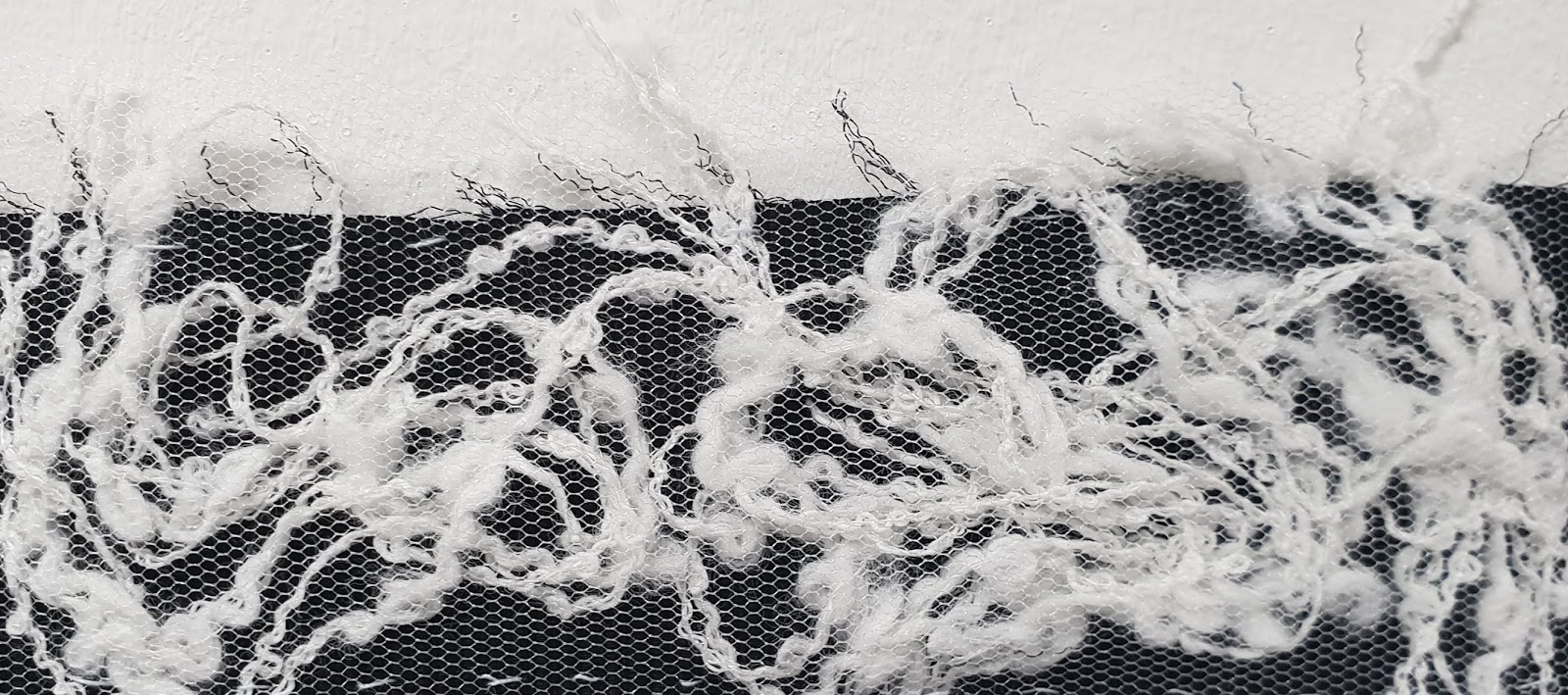
I have research the artists Issey Miyake and Iris Van Herpen for pleat inspiration which are absolutely fascinating, and I would love to know how to pleat like that without stitching.  For a start the company International Pleating in New York has an interesting guide to pleating styles and methods (www.international pleating.com/wp-content/uploads/2014/02/Intl_Pleating.101.pdf).

 Iris Van Herpen

Issey Miyake


Final Evaluation Unit X 2020

Final Evaluation Unit X 2020 During Unit X I have developed some ideas which were started towards the end of the practice unit.   In...