Tuesday, 14 May 2019

Unit X Blog 3 Wearing Plato’s Disco


Wearing Plato’s Disco


Visiting the Whitworth Art Gallery as a group, there was so much inspiration to be taken, but we decided on the permanent installation Plato’s Disco by David Bachelor.  


As a group, we communicated quite well from the beginning, in the form of what we wanted to make and with the help of inspiration mood boards and discussions.  In our mood boards we added pictures from the galleries we visited and images from our research to give us an idea of pathway.  From this we decided on making jewellery, using fabric and glass.  When I came up with the design ideas for the necklaces, I sent drawings to Matty Hall so he could understand what I was aiming at.  We also discussed size and shape before he made the glass pieces. 


I was glad to have collaborated with Matty in the end, because the glass and textile work blended well together to make jewellery and we really kept to the inspiration, colour, shapes and theme. He produced the glass pieces while I laser cut organza fabric and constructed the jewellery using wire.   When I first tried this, I used thick embroidery thread, but it was too floppy.  I used wire to thread the glass pieces and the laser cut organza quadrilaterals, alternating with beads, according to my designs. I decided to use beads in between the organza as spacers because I wanted it to be less dense and I thought it looked nice on the first sample.  I then threaded waxed cord using a slip knot to finish of the necklace. The slip knot I learnt from my tutor gives the adjustment to the necklace length.  I first thought of using manufactured fastenings such as clasps, but that wouldn’t have had as much adjustment as I would have liked, and I also wanted the finishing to be handmade.  We have produced four pairs of earrings and four necklaces and also made one bracelet to go with all of them.

 Display at the Craft centre

At first one of our group members couldn’t take part with Matty and myself, but later he took the colour and inspiration from Plato’s Disco to match with our theme.  For the final exhibition he made a jewellery box and some display stands for the necklaces, which made a great difference for the display.  I was disappointed about the one-minute video we had to present for the exhibition at the Craft and Design Centre, because we were advised to format it in landscape, but we hadn’t read the full description given to us properly and ours was portrait.  If I have to make a video again for a future project, I will keep in mind to use landscape.  I wore the jewellery we produced, so that Matty could take photographs for the exhibition.  I haven’t shown many from the front, because I felt uncomfortable.  In the future I would try to leave plenty of time to get professional photographs of my work.


I would take forward the skills I have gained through jewellery making such as laser cutting and knotting. As I have explained in my previous blog, I singed the organza fabric to stop it fraying and it was too rough around the skin whereas laser cutting was efficient, sealed the edges and was safer. 
First sample (singed version)

Laser cut pieces

In feedback for my previous project, my tutor advised me to interrogate and refine samples to focus on the actual outcome.  In the beginning of this project (Whitworth Threads) I was again tempted to experiment and produce different types of samples with excitement instead of following the theme, but I have tried really hard to stick to one method of production and to refine it.  This is what I have learnt for this project.  I have also learnt and discovered that it is possible to collaborate with 3D students, this way you are getting out of your comfort zone.  At first, I thought it wasn’t going to work, working with 3D students, because it’s completely different to what I’ve done before but, when we discuss our thoughts in groups and in tutorial, I’ve learnt to make it work.  

Thursday, 4 April 2019

Unit X blog 2 -- Whitworth Threads


Blog 2  Whitworth Threads


Plato’s Disco, a stained glass installation designed by David Bachelor, is what Matty Hall and I are inspired by from the Whitworth Art Gallery.  It is a beautiful permanent installation that is hung from the ceiling over a staircase, which has a natural light coming through.  This gives different effects as the colourful, geometrical installation rotates.  For the mid-unit presentation that was held at the Whitworth Art Gallery, Matty and I had to present our work to a member of staff and my tutors. Matty and I were not planning to collaborate at first, because there had been so many changes to the group that I thought it would too complicated to find a joint direction.  However, after talking to my tutors I was encouraged that we could combine glass work and textile together.  


We are collaborating to make jewellery.  Matty is going to produce glass pendants which I can then incorporate into jewellery with textiles.  I have taken my colour inspiration from all around The Whitworth and colour, as well as shapes and form, from Plato’s Disco.  The first necklace I produced looked as I intended, but the texture was too rough on the skin because I had singed the organza fabric shapes with a candle flame to stop the edges fraying.  From the mid-unit review I learnt that the material I wanted to use can be cut using a laser cutter.  I used bought beads for the spacing in-between the geometrically cut fabric pieces which I like and will use again together with Matty’s work.  I have now laser cut four different coloured organza fabrics and these have a much smoother finish, so I hope they won’t be rough on the skin.  I had to design the shapes I wanted on Illustrator and then set the laser cutting software to repeat the squares and diamond shapes, it was very exciting to see the cutting process. 


I have produced a lot of drawings of design ideas and from them we’ll mainly concentrate on earrings and necklaces because these are more commonly sold as sets. 


I need to do more research on fastenings for necklaces, especially an option for extension or reduction in length so there will be more than one choice in wearing.   As it is getting close to the end of the project, I need to start putting things together.   The plan is to get the glass pendants by the end of this week from Matty so I can put all the pieces together to make the final products.  As part of the project we, as a group, have to produce a 1 minute video which can include talking about our inspiration in front of Plato’s Disco or showing our work in progress.   We will have one week after the Easter holidays to finalise our project. 

Sunday, 17 March 2019

Unit X blog 1 – Whitworth Threads


Unit X – Whitworth Threads

During the first week we had introduced ourselves through speed dating and by taking in an A3 poster of previous projects.  This was because we all came from different courses, such as 3D design, as well as Textiles.  At the end we had to split ourselves into groups of four, and we were two students from Textiles in Practice with two 3D Design students.  For our pilot project we had to collaborate to produce a decorative or a functional object for a table. We had decided to make a fruit bowl with elements of wood, glass, printing and embroidery, but two people from my group decided to move to other options so there was only me and Matty.  Matty, who works with glass, made some coasters and I made a tablet mat.  If just the two of us had been together from the beginning, we would have thought more clearly about what we could have made by combining our skills.

the first project we were planning to do with Joe, Anisha, Matty and myself.


Matty Hall's work for the pilot project

My work for the pilot project

In the second week we’ve had another student in our group, Ioan Phillips, who works in wood.  We were given the task to analyse and compare the products sold at the Manchester Art Gallery and the Whitworth to understand the product range and price points as well as customer demographic.


I was really looking forward to the Whitworth Research Visit on Thursday the 14th of March, but I had flu and couldn’t go.  However, the three of us have been to Manchester Art Gallery and The Whitworth to do retail analysis and to get inspiration from the gallery as well as the shops.  Both places sell similar products, but the Manchester Art Gallery sells more jewellery which is what my team and myself are interested in.  For the final piece for Unit X – Whitworth Threads, we are meant to collaborate to design and make a product suitable for the shop.

inspirational board

This is our inspirational board where we've added pictures from the two galleries as well as online based inspiration and we developed our colour theme from the images  


These are some of my inspirations for textile jewellery.


We have talked it through, and we all seem to be keen on jewellery making, combining wood, glass and fabric together or even taking form or colour and making individual jewellery pieces using our own speciality.  I am quite enthusiastic about this learning process because from my recent research there is a lot of potential for textile jewellery making. I think textile jewellery making would be really interesting for the Whitworth shop because the gallery specialises in textiles.


Whitworth Art Gallery


Manchester Art Gallery, Jewellery Collection  

Royal Exchange Theatre and Franny and Filer jewellery display 


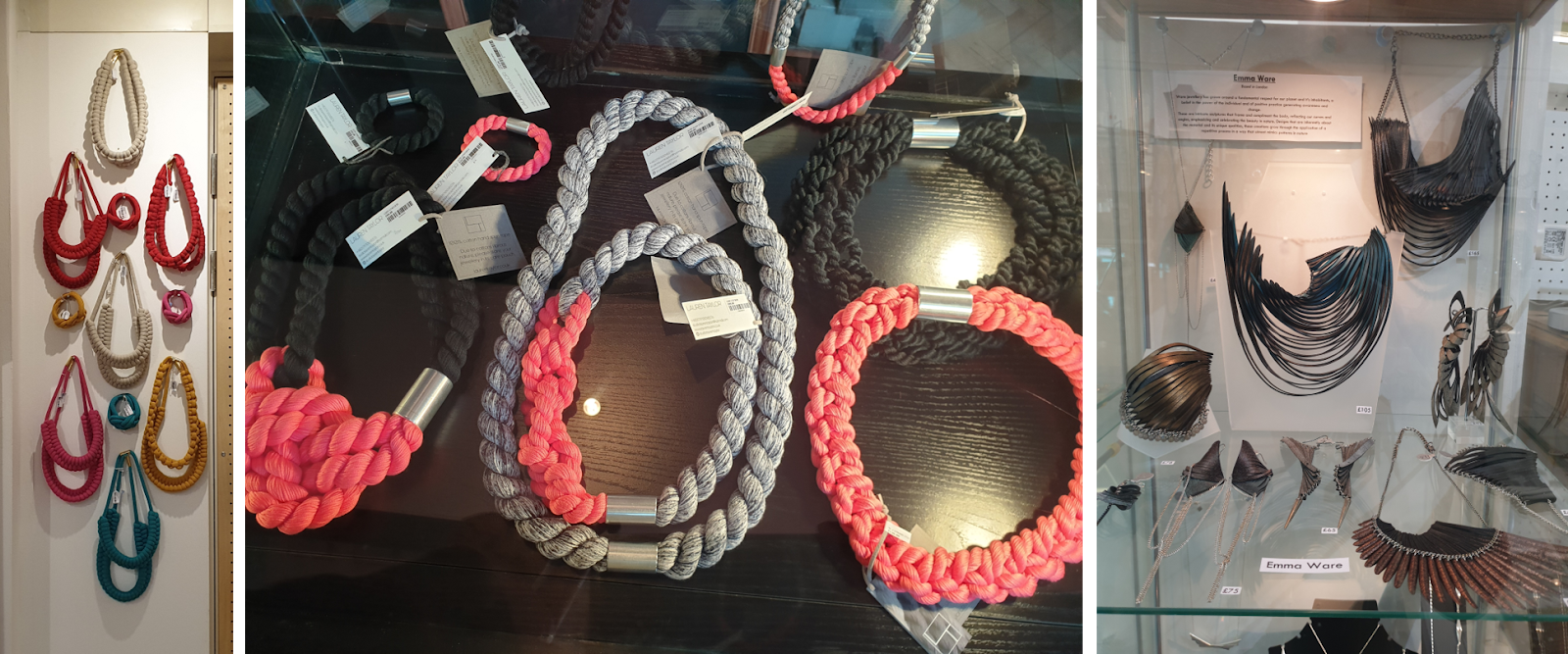
I have done research on textile jewellery for inspiration as well as artist research which have been quite inspirational.  For example Tanvi Kant’s work which is based mainly in recycling where she takes her mother’s sarees and unpicks them to reuse. She explains the personal connection that comes from getting her contrasting raw materials this way.  I am interested in recycling and glad to have found another method for reusing unwanted materials .  Her use of colours seems to be rich and vibrant which is what I’ll be using.  She has designed necklaces and bracelets and I love the way she has found a style of fastening without adding another material.

Tanvi Kant


Rachel Darbourne went to Middlesex University, and finished  her degree in jewellery in 1994. She has since refined the techniques in textiles where she produces wearable jewellery pieces that are colourful and tactile, using “pre and post recycled materials in a unique way”.  Rachel’s work attracted me because of the use of colours and the style of construction. 

 Rachel Darbourne

 I went to Franny and Filer for more jewellery research and came upon Rachel Darbourne's work displayed in a glass cabinet and I think this is probably the way we'll display our work.


Rachel Darbourne, from Franny and Filer shop (Beech Road, Chorlton)

Another inspiring artist, Luis Acosta has been a textile and paper jewellery designer since 1996. He works from his home studio and is very well known internationally. He started off as a weaver and because of that his work represents patterns of repetition.  When he finds a form, he tends to enlarge and repeat it.  Shapes and colours are a big thing in his designs as I have observed. I was inspired by his repetitive style and use of shapes and colours.

Luis Acosta


Friday, 15 February 2019

Evaluation - Locating Unit Project Briefs


Blog 7


Evaluation - Locating Unit Project Briefs


The journey through the Locating Unit has been challenging, working through two different briefs within the time.  The first brief I worked on was the Engineering Embroidery project.  For this I had to produce designs for the interior of a Rolls Royce, which I learnt was a very luxurious brand.   I have brought into this the embroidery skills I have learnt over the two years of university and designed the inside of the roof of the car because for me that was the most interesting place for a bespoke design.  Starting from this I have produced a range of coordinated samples.   The methods I have used for my samplings are tailor tacking, smocking and hand printing using pigment dye as well as using embellisher.   I have experimented with some other techniques but the samples I have really enjoyed working with are pigment dye and tailor tacking on top.


I chose the “The Association of Fashion and Textile Courses Award” which is part of the “Bradford Textiles Prize” for my second brief.  I chose this brief because recycling was involved.  I have gone around getting discarded materials from the fashion bins in the university as well as from charity shops.   By collecting the materials, I have constructed samples to demonstrate how we can recycle and re-use fabrics.  People throw away meters of materials sometimes in the fashion bins, which extremely useful because I feel it is better to reuse than to buy.   I have also recycled in previous units. 


I took my inspiration for this brief from the Manchester Museum because I’m really interested in the marks that showed in the fossils.  I have used pin- tucking, tailor tacking, smocking, applique, machine embroidery, trapping yarns in between sheer and solid fabrics, as well as using puff binder.   For one of the applique samples I burnt strips of synthetic organza and used French knot to attach it.   My samples are going to be adapted into fashion.   


My colour theme is very subtle with monochrome and a few other colours such as yellows, blues and browns that I took from the pictures I had taken of the fossils but, to my disappointment, my samples are mainly monochrome.  I need to look at my colour theme and samples regularly as I work, to see where I’m going and try to use the full range of colours.  In the first project I’ve brought in a lot of colour by dyeing and printing which I really enjoyed, and I should have brought some of that into the second project. 

When I look at the two sets of samples side by side, I’m much happier with the Rolls Royce project because of the colours and methods.  I need reduce the size of the samples, because some methods take a long time and by cutting down, I could concentrate on other work.  For future projects I would like to concentrate more on developing pin tucking, tailor tacking and smocking, fabric dyeing and printing.


Friday, 8 February 2019

Blog 6

Blog 6


I’ve submitted my choices for Unit X this week and then I’ve mainly concentrated on sampling.  For this project I have been following the recycling brief by going through the fashion bins in uni and charity shops, to collect fabrics to embellish and manipulate using various methods of embroidery such as burning organza fabric to use as applique. I have also experimented with puff binder, pin tucks, tailor tacking and smocking (because I love the texture of it).

Tailor tacking


Pin Tucking


Puff Binding

 I researched the designer Miu Miu (Miuccia Prada) for inspiration for smocking. It was interesting to see her work because she has brought back a traditional method that was used instead of elastic in the past and modernised it, using it in fashion and accessories such as hand bags.

Smocking


Miu Miu (Miuccia Prada)

 Miu Miu (Miuccia Prada)


“The basic aesthetic of smocking may look familiar for its application on babies’ garments or on the traditional workers smocks that were the original application of the technique. Smocking would have been most important at a time before elastic, to allow fabric to be gathered and fitted around necklines and cuffs.” https://www.thecuttingclass.com/smocking-techniques-at-miu-miu/

Final Evaluation Unit X 2020

Final Evaluation Unit X 2020 During Unit X I have developed some ideas which were started towards the end of the practice unit.   In...